
How to Get Cited by AI Search
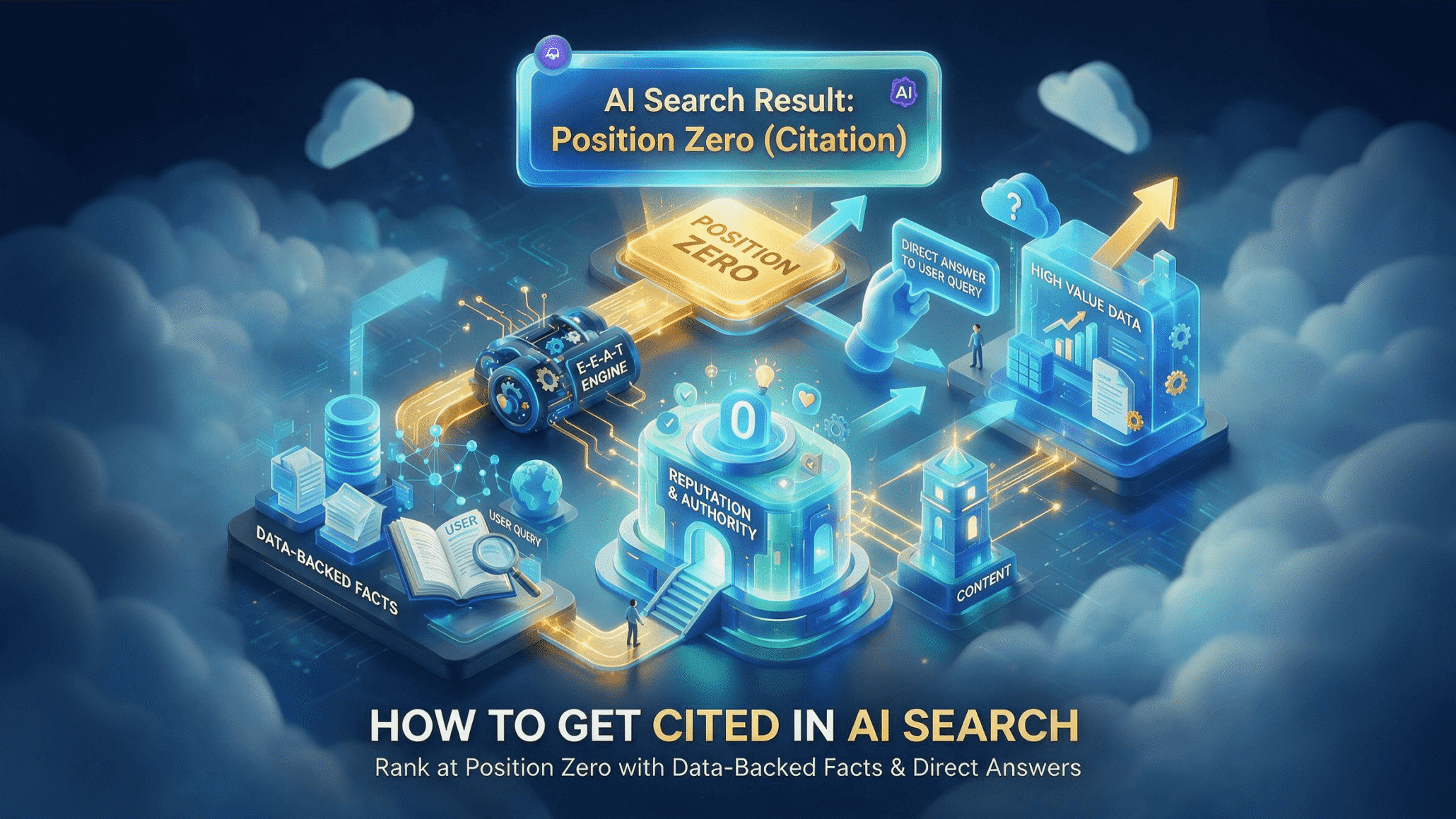
In order to get cited in AI searches, you need to provide a direct answer to the user’s query and share data-backed facts. While these are initial steps to gain appearance in AI results, these alone, however, are not long enough to provide the desired visibility. As a result, many businesses, both small and large scale, often struggle to appear at position zero.
While the factors of visibility in AI search are different from SEO factors, gaining these citations can greatly help businesses improve their credibility, authority and awareness in the competitive market. To ensure that your business ranks on position zero and contributes to the desired overall objectives, we will discuss the key steps that you need to follow to get cited in AI search.
Key Takeaways
- Getting cited by AI search is a share-of-answer game, not just a ranking game.
- AI engines select sources based on entity strength, third-party authority, extractability, and E-E-A-T signals.
- Each AI engine, like ChatGPT, Perplexity, Google AI Overviews and Gemini, weights these signals differently.
- Classic SEO practices form the foundation, but they are not enough to secure AI citations.
- Citation frequency compounds over time, even without direct clicks.
- In addition to search rankings, businesses should also focus on measuring citation frequency, sentiment and share of voice.
Why Getting Cited by AI Search Matters More Than Traditional Rankings Now
The search landscape is shifting rapidly. AIO presence has grown from 30% to 48% of tracked queries over the past year. This means that users were able to find the information they were looking for directly on the overviews without having to open any of the blue links. This marks a significant change in the users’ behavior and how they interact with information.
As users directly get their answers on top of the SERP, zero-click searches are actively changing the overall search experience. Moreover, a SimilarWeb study on zero-click searches shows that about 85% of searches ended with no clicks in 2026.
Due to these statistics, it has become essential for businesses of different niches and scales to gain citations in AI searches.
What Getting Cited by AI Search Actually Means: Mentions vs Citations vs Sourced Answers
A citation by an artificial intelligence engine, like ChatGPT, Gemini, and Google AI overviews, means that the platform has actively selected your specific URL, brand name, or data point as a primary digital footnote to validate a synthesized answer.
Moreover, unlike traditional rankings, AI citations do not rank your business in the list of ten blue links. Instead, they integrate your authority directly into the conversational response.
Below, we have mentioned the key ways in which AI gives citations to a business.
- AI Mentions: The brand name appears inside the generated text because the model recognizes the entity from training data or co-occurrence patterns. It establishes category awareness.
- AI Citations: A clickable URL or reference card is attached to the answer via Retrieval-Augmented Generation (RAG). It proves your content was pulled as factual backing.
- Sourced Answers: The complete structural output where the AI blends internalized knowledge with live web citations to solve the user’s prompt.
Check out our guide on how AI search tenders brand recommendations for more information.
How AI Search Engines Choose Their Sources
AI search engines start by gathering relevant web pages from which they can take the necessary information and provide the user with a direct answer. These engines use a process called Retrieval-Augmented Generation (RAG) to find and provide answers.
Moreover, they do not rank the entire page, but break the text into smaller blocks, score them for clear facts and structure, and pick pieces that best answer the user’s query. Also, note that users’ queries are generally categorized into different classes, like informational, navigational, commercial and transactional, due to this, the types of AI citations can also differ.
Below, we have explained this complex process in simple terms to help you better understand how it works:
- Query Breakdown: The AI splits your question into smaller sub-questions to search for different parts of the topic.
- Live Scanning: It searches the live web or partner indexes to pull a large pool of candidate text blocks.
- Relevance Scoring: It grades each text block based on how direct, factual, and clear the answer is.
- Fact-Checking: It compares the extracted facts across multiple sources to make sure the information matches and is reliable.
The Signals AI Engines Look For When Deciding Who to Cite
AI search engines evaluate content through three main signals, which include authority, content and technical signals. All three of these signals are significantly different from one another, but nonetheless are required to gain citations in AI search.
1. Authority Signals: Build the Third-Party Authority AI Engines Respect
Third-party authority signals provide a significant contribution in lifting citation frequency in AI-generated answers, and they also strengthen citation authority. You can follow the methods we have listed below in order to build this authority.
- Entity Grounding: Secure and align canonical profiles on foundational data layers and industry-specific registries to give AI models a stable, machine-readable identity node.
- Earned Media and PR: Prioritize high-tier third-party press and digital PR, as major generative engines pull a vast majority of their citations directly from credible external publications rather than brand websites, and pages with 32,000+ referring domains are 3.5 times more likely to be cited.
- Ecosystem Consistency: Maintain identical factual claims, business details, and messaging across your owned properties, social channels, and third-party directories. However, do note that these models may downgrade entities when they spot conflicting data.
- Expert Attribution: Use real, named authors with verifiable professional credentials, linked bios, and documented external publication histories rather than anonymous “editorial team” bylines, since adding authoritative quotations can lift citations by 41%.
2. Content Signals: Create Content AI Engines Can Extract Into AI Answers
To get cited by AI search, structure your content around real user questions. Use clear, specific headings that match common queries. Place the direct answer in the first sentence under each heading to help AI systems quickly find and extract key information.
You can follow the practices listed below to ensure optimal content signals that AI engines can understand.
- How-to content should use numbered steps with short paragraphs.
- Comparison content performs best in tables.
- Definitions need concise one-sentence answers under short H2 headings.
- Statistics should be presented in numeric-heavy paragraphs with clear sources.
3. Technical Signals: Ensure AI Crawlers Can Reach Your AI Generated Content
Technical optimization is crucial for AI visibility. This optimization includes adding schema markup, which allows AI engines to effectively crawl and gather information from the web page and give citations. Below, we have listed some of the key configurations of schema markup that you can implement to improve your chances of being cited in AI search results.
- Allow major AI bots: Explicitly permit known AI crawler user agents like GPTBot, ClaudeBot, PerplexityBot, and Google-Extended in your robots.txt file.
- Avoid blanket blocks: Do not use Disallow: / unless you want to hide your entire site from both search engines and AI models.
- Specify paths: Use precise rules to guide bots to public content directories while blocking private user data or admin paths.
In addition to this, AI engines also favor content with:
- Clean HTML
- Minimal JavaScript-only content
- Predictable heading structure
Platform by Platform: What ChatGPT, Perplexity, Gemini, and Google AI Overviews Each Favor
Each AI search engine sources information differently. Due to this, a one-size-fits-all strategy may leave valuable citations on the table. Therefore, understanding these nuances is key to optimizing your content for AI search visibility.
Below, we have explained the primary drivers, what they favor and the citation behaviors of individual AI platforms.
1. ChatGPT
- Primary Driver: Encyclopedic weight, static pre-training data, and selective Bing-backed web retrieval.
- What it favors: High-authority domain names, structured reference content like Wikipedia, and established mainstream media publishers.
- Citation Behavior: The citation behavior of Google Gemini relies heavily on internal knowledge, but activates a Google-backed “Search” mode for real-time validation. Conversely, Microsoft Copilot continuously anchors output using Bing’s interconnected Search and AI Overviews ecosystem.
ChatGPT is one of the most renowned AI platforms and with reliable ChatGPT SEO services, you can ensure that your business is cited on this platform on relevant searches.
2. Google Gemini
- Primary Driver: Google’s broad ecosystem index and deep semantic reasoning.
- What it favors: Clear contextual explanations, multi-modal elements, strong entity footprints, and localized signals like Google Business Profiles.
- Citation Behavior: Pulls from Google’s Knowledge Graph to transform raw data into structured recommendations and structured plans.
This model pulls data directly from Google’s own index. However, about 67% of AI overview citations are not sourced from the top 10 results. Due to this, Gemini SEO services become essential to gain an optimal position on SERP while getting cited by these models.
3. Perplexity AI
- Primary Driver: Live, real-time web retrieval on every individual query.
- What it favors: Peer-to-peer insights, fresh community forums, user discussions (e.g., Reddit), and public relations or press releases.
- Citation Behavior: Highly prolific; cites multiple live sources per response and rewards up-to-the-minute content freshness.
With reliable Perplexity SEO services, you can ensure that your business is meeting all the essential factors to get cited without raising any red flags.
4. Bing Copilot
- Primary Driver: The Bing search index, real-time web crawling, and deep integration into Windows and Microsoft 365.
- What it favors: Official brand websites, technical product documentation, high-authority commercial domains, and structured data like schema markup.
- Citation Behavior: Highly transparent and explicit; it frequently embeds numbered citations tied directly to the current top-ranking pages in Bing’s traditional search results.
5. Google AI Overviews
- Primary Driver: Traditional Google search index coupled with generative synthesis.
- What it favors: Classic high-ranking SEO pages, clear content formatting (bullet points, clear tables), and rich media assets like YouTube videos.
- Citation Behavior: Shows the highest statistical overlap with standard top-10 search engine results pages (SERPs) compared to standalone chatbots.
Do note that the citation factors of Google AI Overviews are different from Google Gemini. In other words, a generic strategy may not provide you with citations on both engines. To ensure that your business is cited in position zero, you can invest in Google AI Overviews SEO services.
How to Measure Your AI Search Visibility and Citation Frequency
Do note that the metrics for AI search visibility are completely different from the SEO ones. Therefore, in order to check how your content is performing on AI engines, you will need to check multiple metrics, like the ones we have shared below.
- Citation Count per Prompt: Tracks how often your brand is cited for specific queries.
- Share of Voice in AI: Measures your mentions as a percentage of total category mentions.
- Sentiment of the Mention: Evaluates whether citations portray your brand positively or negatively.
- AI Position: Indicates where your brand appears within the AI-generated answer.
- AI Referral Traffic: Monitors visits driven from AI platforms.
- Visibility Gaps: Identifies prompts where competitors are cited but you are not.
What to Skip: Overhyped Tactics That Do Not Move AI Citations
When aiming to get citations from AI engines, there are a plethora of factors that you need to consider and about the same amount that you should skip. Below, we have mentioned some of the tactics that you should skip as they provide no real value when it comes to gaining visibility in AI searches.
- Obsessive Schema and Micro-Chunking: While both schema and chunking are essential for AI citations, frantically re-formatting paragraphs or relying solely on technical metadata does not bypass the need for real authority.
- Keyword Stuffing: AI platforms do not prioritize exact keyword matching. Instead, they favor content that answers users’ queries in the best way possible. Due to this, keyword stuffing provides no value for gaining citations in any AI platform.
- Buying Brand-Mention Networks: Purchasing automated, low-quality placements across spam networks to generate superficial mentions signals authority to no one.
- Vague Headers and Generic Structures: Labeling sections with empty phrases like “Introduction” or “Conclusion” because AI models skip these to hunt for high-density information.
- Ignoring Bing Copilot: Neglecting optimization for the Microsoft ecosystem because Copilot uses distinct citation engines that create unique traffic opportunities.
How Levy Online Helps You Get Cited by AI Search
With over 15 years of experience in the field of digital marketing and recognised as a Google Premier Partner 2026 agency, Levy Online has helped a plethora of businesses to gain citations in multiple AI platforms. From AEO and GEO to AIO and SEO, our digital marketing services cover all the essential areas to help your business rise in the competitive marketing and make effective progress towards the desired objectives.
Frequently Asked Questions About AI Search Citations
How do you get cited in AI search results?
To get cited in AI search results, you will need to structure your content to be directly extractable by LLMs, build strong off-site entity authority, and provide verifiable data points rather than vague context.
How long does it take to get cited by ChatGPT or Google AI Overviews?
There is no exact timeframe for getting cited by AI platforms, like ChatGPT or Google AI Overviews. Typically, it can take several weeks to a few months, depending on your business authority and content quality.
How do you get cited in Google AI Overviews specifically?
If you want to specifically get cited in Google AI Overviews, then you will need to optimize for passage-level extraction and entity authority rather than traditional page-level keyword ranking alone.
How do you get cited in ChatGPT?
In order to get cited in ChatGPT, it is essential that your content is first indexed by search engines, like Google and Bing. Then, you must ensure that your content is properly structured and the data is backed by proven facts. Moreover, you will also need to have a high brand authority, as ChatGPT favors authoritative businesses.
Can a small business get cited by AI search if it is not on Wikipedia?
Yes, a small business can be cited by AI search engines without having a Wikipedia page. AI tools like ChatGPT, Google Gemini, and Microsoft Copilot rely on real-time web crawling, local directories, customer reviews, social media, and active website content rather than requiring a presence on Wikipedia.
Do AI search engines use the same signals as Google SEO?
AI search engines use many of the same foundational content signals as traditional Google SEO, such as high-quality content, authority, and relevance. However, they do not prioritize keyword matching or link count. Instead, the focus is on semantic understanding, entity relationships and direct extractability.
What is the difference between AI citations and traditional backlinks?
Traditional backlinks are active hyperlinks from an external website pointing to your page, acting as algorithmic votes of trust to boost organic search engine rankings. AI citations, on the other hand, are dynamic inline references or footnote source cards attached by AI engines that credit your specific content as the direct basis for an answer.