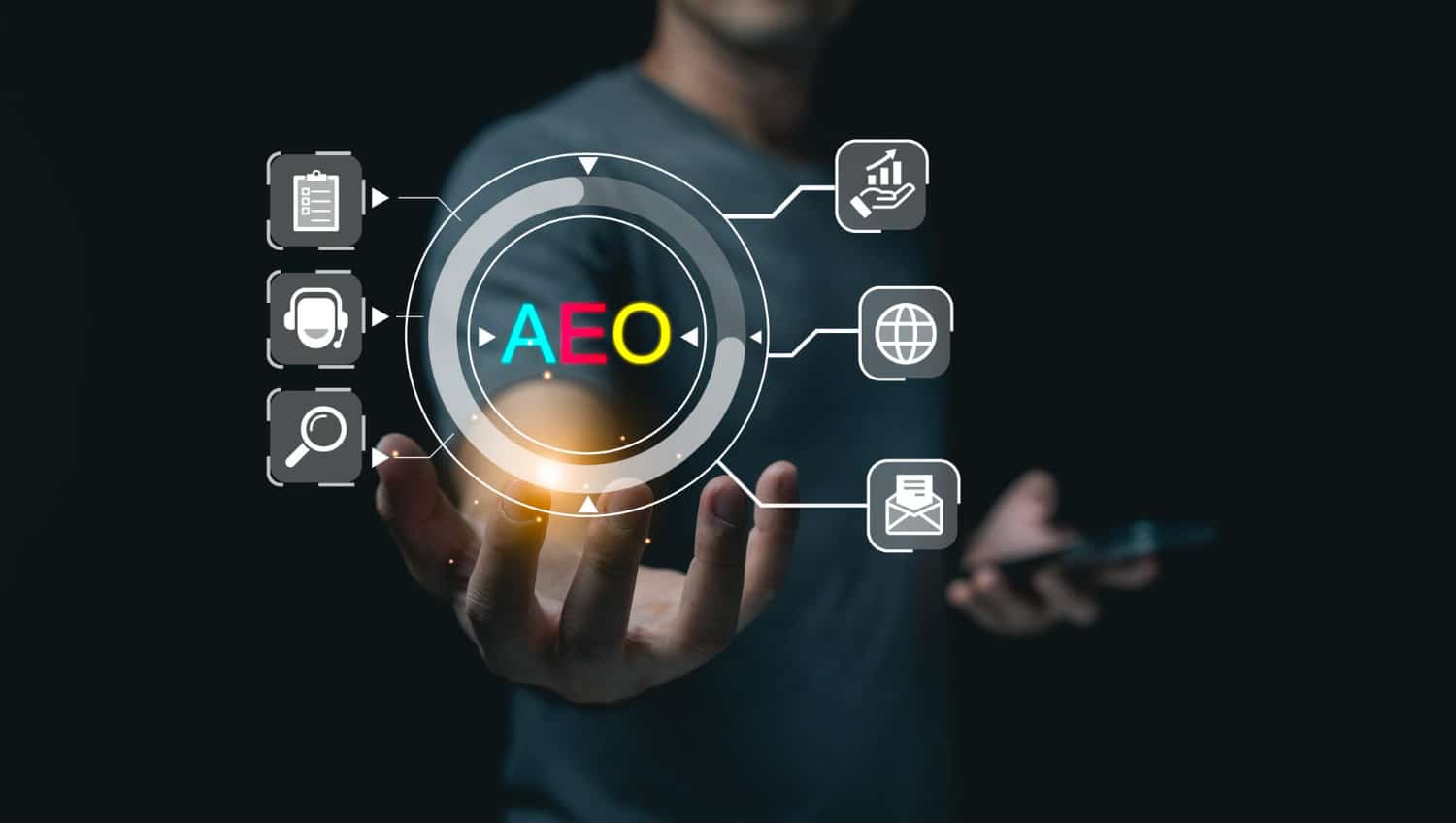
Answer Engine Optimization Services That Drive AI Visibility
Answer engine optimization (AEO) is the practice of structuring your content so AI-powered answer engines-ChatGPT, Google’s AI Overviews, Perplexity, and voice assistants-select and cite your brand as the direct answer to user queries. More than half of searches in 2025 will not lead to a website visit. If your content isn’t appearing in AI generated answers, you’re invisible to the fastest-growing segment of search.
Over 800 million people use ChatGPT every week. Gartner predicts traditional search volume will drop 25% by 2026. The brands investing in answer engine optimization AEO now are the ones capturing visibility while competitors wonder where their organic traffic went.
Levy Online is a Google Premier Partner – a status awarded to the top 3% of participating agencies in the country. With 15+ years of experience adapting to every major shift in search engine optimization, we build AEO strategies that get your brand cited, mentioned, and trusted across AI platforms.
Key Takeaways
- Answer Engine Optimization (AEO) helps brands appear as direct answers in AI-powered search results from ChatGPT, Google’s AI Overviews, and voice assistants.
- AEO targets zero-click searches and AI citations instead of traditional link clicks, capturing visibility in the growing AI search market.
- Levy Online is a Google Premier Partner (top 3% of agencies) with 15+ years of experience adapting to search evolution.
- Our AEO services include content structuring, schema implementation, authority building, and AI visibility tracking for sustained brand presence.
- Clients have seen 40%+ increases in brand mentions across AI platforms and improved conversion rates from AI-referred traffic.
- If your brand isn’t appearing in AI generated answers, you’re missing half of modern search visibility.
Some Of Our Clients









Why Your Business Needs Professional Answer Engine Optimization
Here is the reality: the way people search has fundamentally changed. Zero-click searches now account for roughly 58.5% of all Google queries-users get concise answers directly from featured snippets, People Also Ask boxes, and AI overviews without ever visiting a website. AI tools like ChatGPT provide answers without requiring clicks, and this trend is accelerating.
Traditional SEO focuses on high rankings to earn clicks. It aims to rank pages for clicks in search results. That model still matters, but it is no longer sufficient on its own. AEO focuses on being cited in AI-generated answers-a fundamentally different goal. When someone asks ChatGPT, Perplexity, or Google’s AI Overviews a question, the AI systems don’t simply list ten blue links. They generate answers by pulling from sources they deem most authoritative, structured, and relevant. Being #1 in Google does not guarantee your content appears in those AI generated summaries.
The key differences between AEO and traditional SEO are significant:
- Traditional SEO aims to earn clicks through search engine results pages. SEO success is measured by click-through rates and organic traffic.
- AEO prioritizes being cited as the authoritative answer. AEO success is assessed by brand mentions and citations in AI summaries.
- Content style diverges. AEO requires clear, structured, and trustworthy content. Concise formatting is preferred by AI engines over long-form prose. Content should focus on specific, question-based queries for AEO.
- AEO complements SEO by enhancing brand visibility in AI responses. It doesn’t replace your broader SEO-it extends it into the AI-first environment.
The unique challenges are real. AI models use Retrieval-Augmented Generation (RAG) pipelines that retrieve many pages but cite only a fraction-roughly 85% of retrieved pages never make the final citation cut. Your content must be structured for AI parsing, backed by authority signals, and written in natural language that matches how people actually ask questions. Complex paragraphs and ambiguous phrasing reduce your chances of being selected.
AEO requires a shift in content creation for an AI-first environment. The consequences of not adapting are straightforward: if AI systems can’t extract clear answers from your content, your brand stays invisible to a growing majority of search interactions. Zero-click searches are increasing as users expect direct answers, and competitors who optimize for answer engines will capture the consideration phase your brand is missing.
What Makes Levy Online the Premier Answer Engine Optimization Agency
Levy Online is not a generalist agency applying yesterday’s playbook to today’s AI search landscape. We are a boutique answer engine optimization agency with the resources, expertise, and track record to deliver measurable AI visibility.
Here is what sets us apart:
- Google Premier Partner in the top 3% of agencies – a distinction that signals proven performance and trust across the digital marketing ecosystem.
- SEO specialists ranked in the top 2% of the field, with deep expertise in technical SEO, content strategy, and the structured data implementations that AI platforms prioritize.
- 15+ years building and executing search engine optimization campaigns for brands like the World Series of Poker, Fremont Street Experience, Las Vegas Monorail, and Caesars Casino-adapting through every major algorithm shift, from Panda to AI Overviews.
The results back up the credentials: clients working with our AEO strategies have seen 40%+ increases in brand mentions across AI platforms, along with measurably higher conversion rates from AI-referred traffic. In 2025, AI search visitors convert 4.4 times better than organic search visitors-and our strategies are built to capture exactly that advantage.
Where larger agencies assign junior account managers and cookie-cutter approaches, we provide boutique-level attention from senior strategists who understand the nuance of optimizing content for both search engines and AI answer engines.
Our cross-industry experience-spanning e-commerce, hospitality, legal services, and entertainment-means we approach your brand’s AI visibility with a broader strategic lens than agencies locked into a single vertical.

Comprehensive Answer Engine Optimization Services We Provide
Our answer engine optimization services cover every dimension of AI visibility, from how your content is structured and marked up to how it is perceived by AI models across platforms. Each service is designed to position your brand as the cited source when AI systems generate answers for your target audience.
Content Structure Optimization for AI Systems
Content structure is where AEO begins. AI powered answer engines don’t read content the way humans do-they parse, extract, and evaluate whether a piece of content can cleanly answer a specific user query. If your content can’t be “lifted” into an AI response, it gets skipped regardless of how well it ranks in traditional search.
Our content structure optimization includes:
- Answer-first formatting. Use a 30 to 60-word direct answer at the top of content so AI models can immediately extract the core response. Use atomic paragraph structures of 1 to 3 sentences that each address a specific sub-question.
- Question-based headings. Use clear, question-based headings that mirror user queries-“What is…?”, “How does…?”, “Why should…?”-because this is how people search and how AI systems match search intent to content.
- Bullet points and structured lists. Content should be structured in Q&A format with clear headings. Bullet points make content extractable and scannable for both AI and human readers.
- FAQ section implementation. Implement structured data and FAQ schema to enhance AI visibility. FAQ blocks on existing pages are among the fastest wins in AEO.
- Voice search optimization. Voice assistants like Siri, Alexa, and Google Assistant pull from structured answers. We optimize for conversational, natural language phrasing and long tail queries that match how people actually speak.
- Content refresh strategy. Refresh content regularly with updated dates and credible sources. Research shows content updated within the last 30 days receives approximately 3.2× more AI citations.
High readability is essential for content to be favored by AI models. Every paragraph we optimize is built to be machine-readable while remaining engaging for human visitors.
|
Feature |
Traditional Content |
AEO-Optimized Content |
|
Opening paragraph |
General introduction |
30–60 word direct answer |
|
Paragraph structure |
Long, multi-topic blocks |
Atomic: 1–3 sentences per idea |
|
Headings |
Keyword-focused |
Question-based, mirrors user queries |
|
Formatting |
Prose-heavy |
Bullet points, numbered lists, tables |
|
Tone |
Formal / keyword-dense |
Conversational, natural language |
|
Freshness |
Updated occasionally |
Regularly refreshed with timestamps |
|
Schema |
Often absent |
FAQPage, HowTo, Article implemented |
Technical AEO and Schema Implementation
A solid SEO foundation is non-negotiable for AEO. If AI crawlers can’t access, parse, and understand your site’s technical elements, no amount of content optimization will get you cited. Our technical SEO work for AEO goes beyond traditional requirements.
Schema markup implementation is central to AEO. Structured data helps AI systems understand entities, relationships, and the purpose of your content. We implement and validate:
- FAQPage schema for question-and-answer content blocks.
- HowTo schema for instructional and process content.
- Article schema for blog posts, guides, and thought leadership.
- LocalBusiness schema for location-based businesses seeking voice search and local AI visibility.
- Review schema for reputation signals that AI systems weigh when assessing trust.
Implement structured data and FAQ schema for better visibility across all major AI platforms.
Beyond schema, our technical AEO work includes:
- AI crawler access verification. We confirm that GPTBot, ClaudeBot, and other AI crawlers can access your content via properly configured robots.txt and XML sitemaps.
- Site speed optimization. Voice search and AI assistants prioritize fast-loading pages. We optimize server response, caching, and image compression.
- Mobile-first readiness. The majority of voice queries come from mobile devices. Your site must render flawlessly on every screen size.
- Internal links architecture. Strong internal linking supports topical authority and helps AI systems understand content relationships across your site.
- Structured data validation. Every implementation is tested via Google’s Rich Results Test and Schema validators to ensure error-free JSON-LD.
|
Schema Type |
Best For |
AI Platform Impact |
Priority |
|
FAQPage |
Q&A content, service pages |
High: directly maps to question-answering |
Critical |
|
HowTo |
Process guides, tutorials |
High: step-by-step extraction |
High |
|
Article |
Blog posts, thought leadership |
Medium-High: establishes entity authority |
High |
|
LocalBusiness |
Regional businesses |
High for local/voice queries |
Critical for local |
|
Review |
Products, services |
Medium: trust signal for AI citation |
Medium |
|
Voice assistant content |
High: voice-specific extraction |
Growing |
Answer Engine Optimization Strategies That Deliver Results
Beyond core services, our team deploys layered AEO strategies that compound over time-building the authority, visibility, and trust signals that AI systems rely on when deciding which sources to cite.
Authority Building for AI Trust Signals
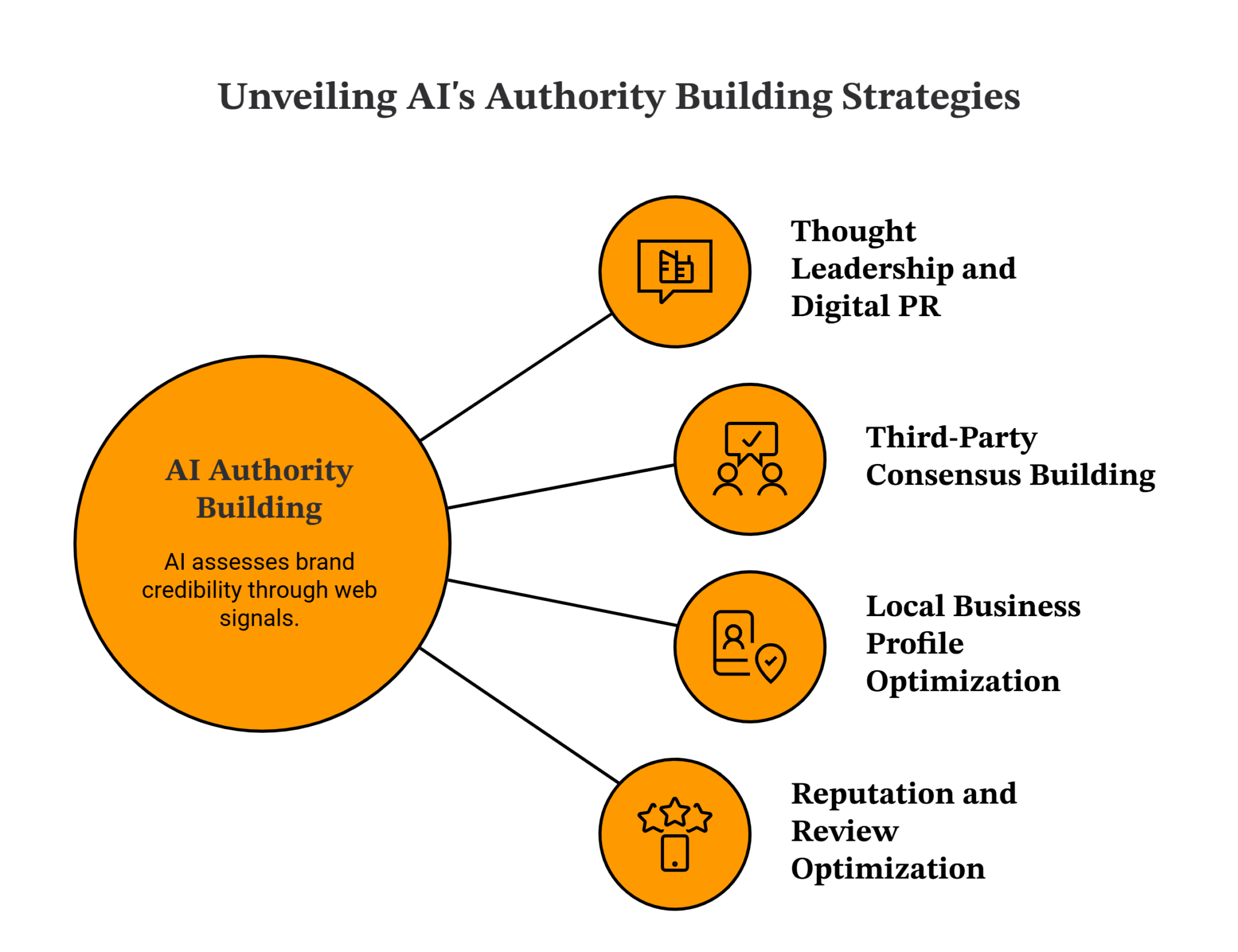
AI systems don’t cite content in a vacuum. They assess brand credibility through a web of signals: domain authority, third-party corroboration, E-E-A-T signals (Experience, Expertise, Authoritativeness, Trustworthiness), and consistency across the web. Authority signals help AI systems determine content trustworthiness.
Our authority building strategies include:
- Thought leadership and digital PR. Guest posts, expert contributions to industry publications, and press features on third party sites that are indexed and referenced by AI extractors. Link building remains critical-but the goal is now earning citations on AI-referenced sites, not just passing PageRank.
- Third-party consensus building. Research shows that when multiple independent sources corroborate the same information, AI models have higher confidence in citing that content. We build content ecosystems where your brand’s expertise is validated across authoritative domains.
- Local business profile optimization. For businesses with physical locations, we optimize Google Business profiles, Bing Places, and Apple Business listings. Consistency of business data across platforms directly influences local AI search visibility.
- Reputation and review optimization. Reviews provide extractable trust signals that AI platforms weigh heavily. We ensure review data is structured, review schema is correctly implemented, and your brand actively manages its reputation across platforms.
If your brand has little online authority, these strategies are essential to breaking into AI answers. For established brands, they accelerate the compounding effect of existing trust.
AI Visibility Tracking and Optimization
You can’t improve what you don’t measure. Unlike traditional SEO, where Google Search Console and analytics platforms provide clear data, AI visibility tracking requires a different approach. AEO monitors featured snippets and “People Also Ask” sections for performance, but it goes much further.
Our tracking and optimization framework includes:
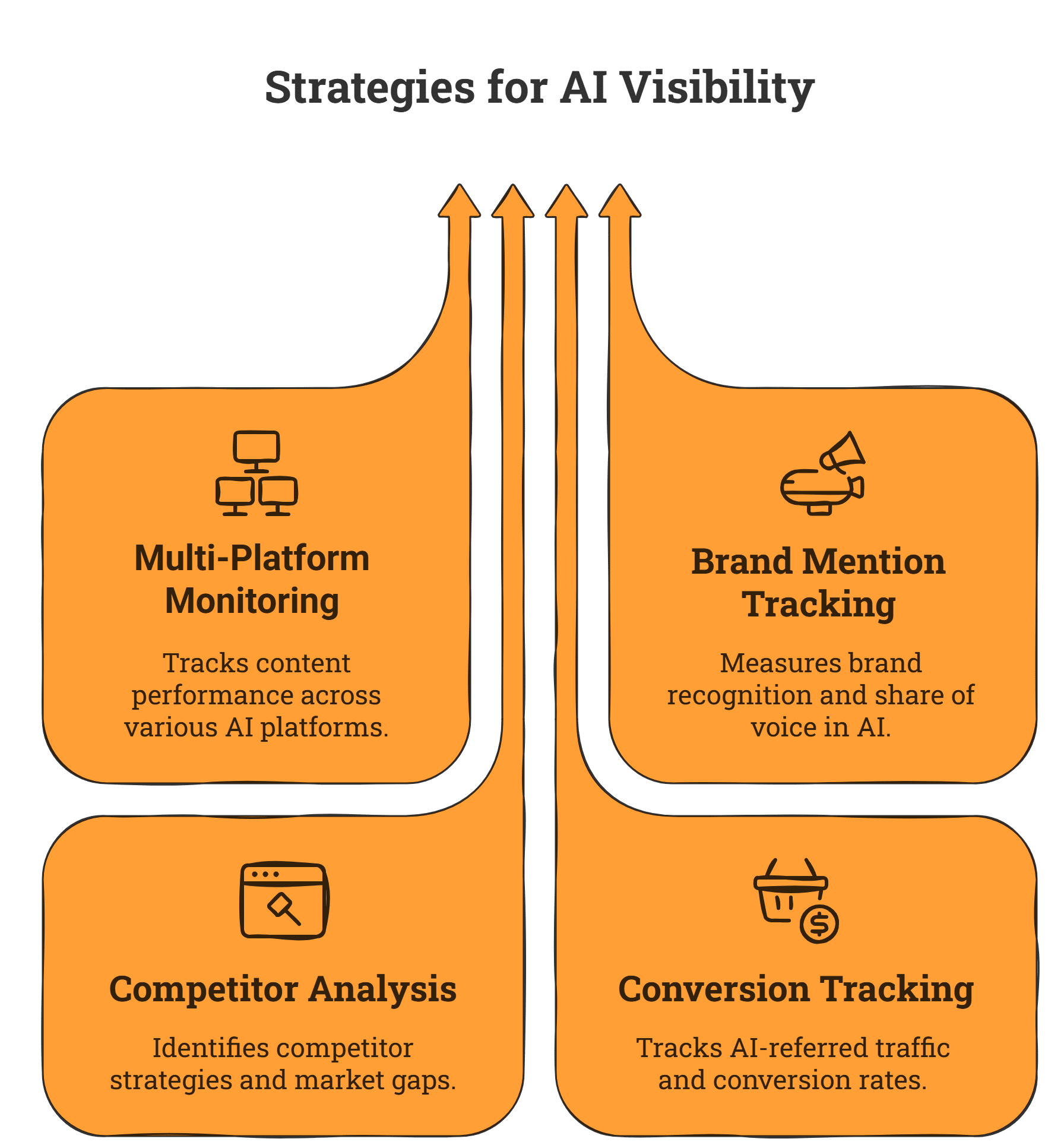
- Conversion tracking from AI-referred traffic. Define AEO KPIs to track visibility and influence in AI responses. Through UTM tags, referral sensors, and AI-source analytics, we measure leads, conversion rates, and revenue from AI-referred visitors. In 2025, AI search visitors convert 4.4 times better than organic search visitors-making this data essential for ROI calculation.
- Multi-platform monitoring. We regularly query core buyer questions across ChatGPT, Perplexity, Claude, Gemini, and Google AI Overviews to track whether your content appears as the answer, whether it’s cited, and which URLs are referenced.
- Brand mention tracking and share of voice analysis. Track AI citations and brand mentions to measure AEO success-not just when you’re cited with a link, but when your brand is mentioned by name in AI responses. We measure your share of voice relative to competitors for relevant queries.
- Competitor AI visibility analysis. We identify which competitors are being cited in AI answers for your target search queries, what content formats they use, and where gaps exist that your brand can fill.
Our Proven Answer Engine Optimization Process
Results don’t come from scattered tactics. They come from a disciplined, repeatable process designed for the unique demands of AI search. Here is how we run every AEO engagement.
Every engagement begins with a thorough analysis of your current AI presence. We assess:
- Current AI platform presence. We test your brand across major answer engines-ChatGPT, Perplexity, Google AI Overviews, Claude, Gemini-for your core buyer queries. Do you appear? Are you cited? Are you mentioned without a link? We document everything.
- Competitor AI visibility benchmarking. For the same buyer questions, we test your competitors. We measure their citation share, content formats, schema usage, and trust signals to establish a clear competitive baseline.
- Content gap analysis for question-based queries. We map common customer questions across the buyer journey and identify where your content is missing, or present but not structured for AI extraction. Content should focus on specific, question-based queries for AEO.
- Brand authority assessment. We evaluate your trust and credibility signals: domain age, backlink profile, external mentions across trusted web sources, schema richness, review data, and entity presence across knowledge graphs.
Think of it as a diagnostic that tells us exactly where your brand is visible in AI-and where it’s invisible.
Based on the audit findings, our specialists build a custom strategy with clear milestones:
- Prioritize quick wins first. FAQ blocks on existing high-traffic pages, schema implementation on service pages, and structural tweaks to content that is already close to being cited. AEO optimizes for “Position 0” to enhance citations by machines.
- Build long-term authority. Content development for priority queries, entity authority building through external citations, and topical cluster strategies that establish your brand as the definitive source. 99% of URLs shown in AI Mode appear in the top 20 organic results-so a solid SEO foundation remains essential.
- Content restructuring timeline. Phased approach: restructure existing content → create content for priority gaps → implement schema markup → establish content refresh cadence → monitor and optimize.
- Technical optimization schedule. Schema types prioritized and implemented, AI crawler access confirmed, site speed benchmarks established, mobile readiness verified.
Strategy only works when aligned with your business goals, so every recommendation maps directly to revenue outcomes.
We set up comprehensive tracking from the start. Monthly reports cover:
- AI citation metrics. Citation frequency across platforms, source URLs used, mention vs. citation visibility for your top queries.
- Brand mention tracking. How often your brand appears in AI responses-with or without links-and how that compares to competitors. AEO success is assessed by brand mentions and citations in AI summaries.
- Conversion data from AI-referred traffic. Leads, conversion rates, and revenue attributed to AI sources. We track how AI-referred visitors behave compared to traditional organic visitors.
- Competitive share of AI voice. Monthly comparison of your AI visibility against key competitors for shared query spaces.
You won’t get vague summaries. You’ll get clear data showing exactly what we did, what happened in AI search results, and what comes next.
AI search evolves rapidly. Search platforms update their models, change citation behaviors, and introduce new features. Our ongoing work ensures your brand stays visible:
- Content refinement based on performance data. We refresh, merge, or expand content based on what AI platforms are citing and what they’re skipping. Regularly refresh content with updated dates and credible sources.
- Adaptation to new answer engines and AI search features. As generative AI evolves-new models, new features, new search platforms-we monitor and adapt your strategy to maintain and grow visibility.
- Authority and citation growth. Continuous outreach, partnerships, press features, and review generation to strengthen the trust signals AI models rely on.
- Scaling as goals evolve. Expanded content production, multi-location targeting, voice assistant optimization, and internationalization as your business grows.
The ROI of Professional Answer Engine Optimization Services
The cost question is fair, so let’s address it directly. Professional answer engine optimization is an investment that compounds-and the data makes the case clearly.
AEO aims for immediate, comprehensive answers without clicks. That means your brand gets visibility even when users don’t visit your site, translating into brand awareness, trust, and consideration that drive downstream conversions. AEO enhances brand visibility and builds trust with users at the exact moment they’re seeking answers.
Consider the evidence from published case studies:
- NerdWallet grew full-year 2025 revenue 22% to roughly $837 million even as organic search traffic kept falling, with CEO Tim Chen crediting performance marketing, direct, and non-search referral channels for offsetting organic search headwinds “as consumers turned to AI overviews and LLMs over traditional search.” It’s a clear sign that business results no longer track raw search traffic.
- AI-referred visitors are roughly 4.4x as valuable as traditional organic-search visitors by conversion rate, because the LLM has already answered their questions and compared their options, so they arrive pre-qualified and close to a decision.
Over a 3-year horizon, AEO delivers compounding returns. Once citations accumulate, they reinforce topical authority, improving future inclusion and entity strength across knowledge graphs. Compare this to Google Ads, where you pay for every click and build no lasting asset. AEO complements SEO by enhancing visibility in AI responses while reducing dependency on paid acquisition over time.
The business metrics extend beyond traffic: higher lifetime value leads (because AI reduces friction-users arrive already informed), lower customer acquisition costs, and shorter sales cycles.
Why Businesses Choose Levy Online
Las Vegas is one of the most competitive digital marketing environments on the planet. Entertainment, hospitality, retail, legal-every industry here fights for visibility in a market that demands results. That is the environment we built our expertise in, and it’s why our strategies perform in any market.
We understand a wide range of business needs because we’ve delivered results across industries that couldn’t be more different-from restaurant marketing to casino entertainment to construction company lead generation. That cross-industry portfolio means we approach your brand’s AI visibility with strategic depth that single-vertical agencies simply can’t match.
Our proactive adaptation to AI search evolution is what separates us. While other agencies are still debating whether AEO matters, we’ve already built the frameworks, visibility tools, and measurement systems that get brands cited across AI platforms. Generative engine optimization isn’t a future concern-it’s a present requirement, and we’ve been building for it.
You get direct access to senior strategists, not a junior account manager reading from a script. When you have questions about your brand’s performance in AI responses, you get answers from the specialists doing the work. That accessibility, combined with local expertise and global capability, is why businesses choose Levy Online.

Get Started with Answer Engine Optimization Now!
GeGetting started is straightforward. Here is what the first 30 days look like:
- Free Consultation: We discuss your business goals, current challenges, and what AI visibility success looks like for your brand.
- AI Visibility Audit: Our team conducts a comprehensive analysis of your presence across answer engines, competitor benchmarking, and content gap assessment.
- Custom Strategy Presentation: We present a detailed roadmap with priorities, timelines, and projected outcomes tailored to your industry and target audience.
- Implementation Begins: Quick wins go live immediately-schema markup, content restructuring, FAQ implementation-while we build the longer-term authority strategy.
No long-term contracts required to start. No vague promises. Just a clear plan backed by data and a team that understands how AI systems select the sources they cite.
Book your free AEO consultation now.
See How our industry-leading marketing team can help your business
Contact Our Answer Engine Optimization Experts Today
Your competitors are investing in answer engine optimization right now. Every day you wait is another day they capture the AI citations, brand exposure, and qualified leads that should be yours. Gartner predicts a 25% drop in traditional search volume by 2026-the shift to AI search is not coming, it’s here.
As a Google Premier Partner in the top 3% of agencies, Levy Online has the experience and the team to build your brand’s AI visibility from the ground up. We offer a free, no-obligation AEO consultation and audit to show you exactly where your brand stands across AI platforms and where the opportunities are.
Stop being invisible to AI. Start building search visibility that compounds.
Contact our answer engine optimization experts today.