Structuring for LLMs: How Information Architecture and Entity Mapping Drive AI Visibility

Large language models do not just read words. They interpret relationships between entities, topics, and sources to decide which brands are relevant. Your site structure influences how easily AI can understand what you do and whether you deserve to be cited. According to Search Engine Journal, pages with proper heading hierarchy and semantic clarity are far easier for AI to parse. This guide covers information architecture, entity mapping, semantic formatting, and digital PR for AI visibility.
TL;DR
- Large language models do not read websites the way people do.
- They parse relationships between entities, topics, and sources to decide which brands deserve mention.
- Your site’s information architecture, entity mapping, and semantic formatting directly determine whether AI can understand, classify, and credit your business.
- This guide covers how to structure content so LLMs treat your brand as a trustworthy answer, not background noise.
How LLMs Understand the Web
AI engines use web-level signals to connect brands, topics, and industries, relying on web graphs, entity recognition, and source relationships. Clean structure helps LLMs identify your relevance with confidence. As Search Engine Land reports, entity authority is now the foundation of AI search visibility, with Google confirming that AI Mode pulls from the Knowledge Graph during retrieval.
What a Web Graph Represents
Links and mentions create a network of meaning across the web. When multiple trusted sources reference your brand in context, AI reads that as a signal of relevance.
What Entity Recognition Means
Entities are the building blocks AI uses to classify the web: brands, people, products, services, locations. LLMs identify which entities are present on your site and how they relate to broader categories in their training data.
Why Relationships Matter
AI uses connected signals to determine authority and relevance. A brand mentioned alongside recognized industry terms, competitor names, and geographic markers gets classified with far more confidence than one sitting in isolation.
Why Information Architecture Matters
A well-structured site makes it far easier for large language models to parse content. Clear navigation, topic clusters, and page hierarchy tell AI which pages are core, which are supporting, and how they relate. Without that structure, LLMs move on to a competitor whose architecture gives them a clear answer. This is where generative engine optimization starts.
Hierarchy Makes Meaning Clear
Organized page levels help machine reading. A proper H1-H2-H3 nesting structure tells AI what the page is about at a glance, while flat or div-heavy templates bury the meaning. Models perform best when facts are contextually grounded within a clear structure.
Topic Clusters Build Context
Related content grouped around a central theme strengthens topical authority. When your SEO strategy connects pillar pages to supporting articles with consistent internal links, AI recognizes depth of expertise rather than scattered, disconnected pages.
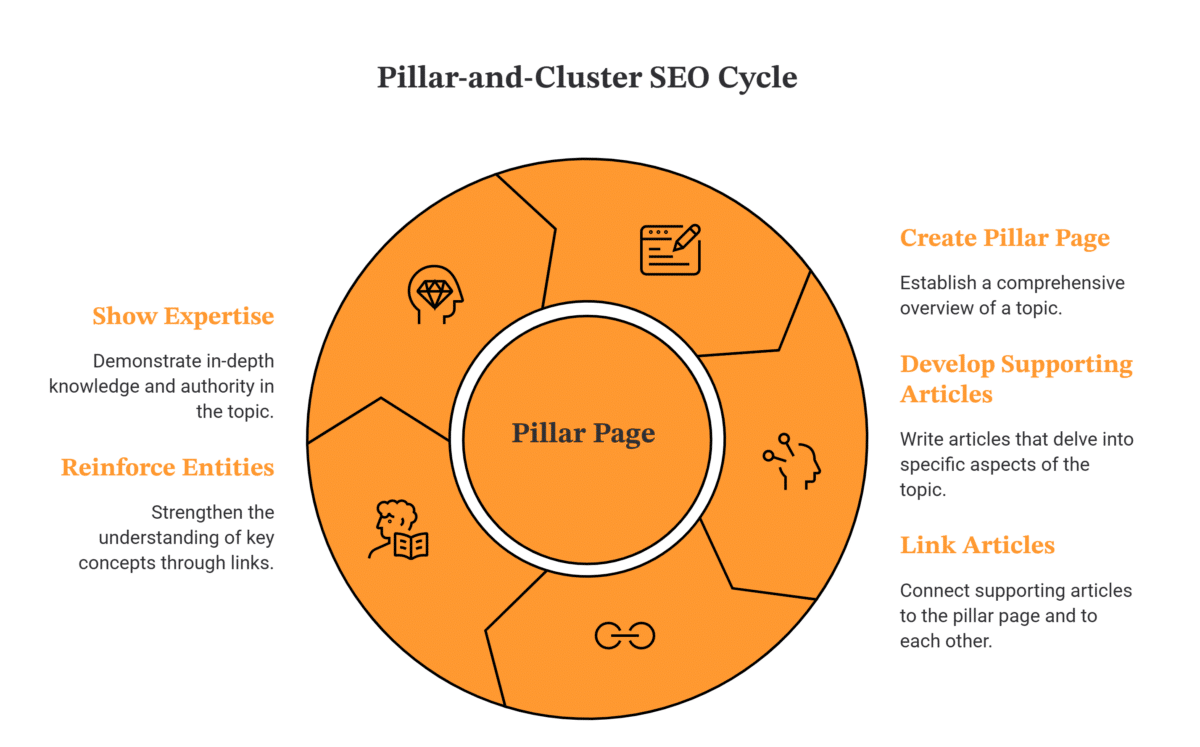
Internal Linking Reinforces Entities
Internal links connect services, categories, and brand signals in a way that tells AI how your offerings relate. Every link is a relationship statement that helps LLMs map your brand.
How Entity Mapping Improves AI Visibility
Entity mapping is the process of making your brand clearly identifiable across every page and platform. AI becomes more confident when it sees consistent names, services, locations, and relationships, reducing ambiguity and improving how often you get cited.
Use Consistent Brand Signals
Keep your brand name, service descriptions, and positioning uniform across your website, directories, and third-party profiles. Inconsistency confuses AI the same way it confuses customers.
Connect Services to Categories
Each offering should map to a clear industry category. If you provide local SEO services, make sure that connection is explicit on the page, in your schema markup, and in how you describe the work. AI needs those category links to classify you correctly.
Include Locations and Specialties
Help AI understand where you operate and what you do best. Including geographic markers and specialty keywords on relevant pages gives LLMs the context they need to recommend you for location-specific or niche queries.
Semantic Formatting for LLM Scrapers
Semantic formatting helps LLMs extract and interpret meaning quickly. Headings, short paragraphs, lists, and concise language reduce ambiguity and surface key ideas. Here is how different formats serve AI extraction:
|
Format |
Best For |
AI Benefit |
|
Clear H1-H3 headings |
Page hierarchy and topic signals |
Quick classification of content theme |
|
Short paragraphs |
Modular, self-contained ideas |
Easier extraction into AI answers |
|
Bullet lists |
Feature lists, steps, comparisons |
Direct snippet-ready content |
|
Tables |
Data comparison, categorization |
Structured data extraction |
|
Schema markup |
Entity definition, FAQ, services |
Machine-readable format for LLMs |
Use Clear Headings
Descriptive H1, H2, and H3 tags act as a roadmap for AI scrapers. Vague headings like “Our Approach” tell AI nothing. Specific headings like “Local SEO Services for Restaurants” tell it everything.
Write in Modular Sections
Short, focused sections are easier for AI to parse than long, winding paragraphs. One idea per section. This is how structured content serves as a roadmap for LLMs, guiding them to identify and extract accurate information.
Use Lists and Tables Where Helpful
Bullet points and tables give AI clean data points to pull from. Pages with lists and comparison tables tend to get cited more frequently in AI responses.
How Digital PR Supports Entity Credibility
Digital PR creates third-party confirmation of your brand’s identity and authority. Features, interviews, citations, and mentions in trusted publications all help LLMs validate that your brand is real and relevant. According to Schema App’s research on entity SEO, brands that are consistently referenced across authoritative external sources are more likely to be surfaced in AI-generated answers.
Third-Party Mentions Add Trust
Outside references matter more than self-claims. When a respected publication mentions your brand, AI treats that as independent validation that on-site copy alone cannot replace.
Coverage Builds Industry Association
Earned media links your brand to its category in ways that AI can detect and store. A feature in an industry publication about digital marketing tells AI you belong in that category, not just that you claim to.
PR Strengthens the Knowledge Graph
Repeated mentions across trusted sources help AI build confidence in your brand’s identity. The more consistently your name, services, and industry appear together across the web, the stronger your position in the knowledge graph becomes.
How to Build an AI-Friendly Site Structure
Turning these ideas into practice comes down to clarity and consistency. Design pages so AI can crawl, classify, and credit them without guessing:
Create Clear Service and Category Pages
Build individual pages around specific topics and offerings. Each service page should state what you do, who it is for, and where. Avoid bundling unrelated services on a single page.
Group Related Content Together
Use topic clusters to show depth. A pillar page on schema markup linked to supporting articles on structured data, entity mapping, and technical SEO signals far more authority than isolated blog posts.
Add Entity-Rich Copy
Include brand names, industry terms, locations, and use cases naturally throughout your content. Generic copy gives AI nothing to classify. Entity-rich language tells LLMs exactly what your business does.
Support Pages With External Signals
Reinforce content with PR coverage and third-party validation. Web-wide signals confirm what your pages claim and give AI confidence to cite you.
Common Technical Mistakes
A few structural errors can quietly undermine your AI visibility. Here are the most common:
Flat or Confusing Navigation
Poor hierarchy makes content harder for AI to interpret. When every page sits at the same level with no clear parent-child relationships, LLMs cannot determine which content is most important.
Generic Copy Without Entities
Vague wording weakens classification. If your service pages use generic language instead of specific brand names, locations, and industry terms, AI has no entities to anchor your content to.
Ignoring External Validation
Site content alone is not enough without web-wide signals. Brands that skip digital PR and third-party citations leave a gap that makes AI less confident in recommending them.
Final Takeaway
AI visibility depends on how clearly your site is structured and how strongly your entities are mapped across the web. Information architecture, semantic formatting, and digital PR work together to make your brand easy for large language models to understand, classify, and trust. The brands that get cited are the ones that make it simple for AI to find the answer.
Contact Levy Online to build an AI-friendly site structure that puts your brand in front of the models that matter.